AI Visibility Study: AI is citing the answers businesses publish
What 12,792 AI answers and 3,127 business websites reveal about local recommendations, reviews and buyer questions.
- 12,792AI answers
- 3,127business websites
- 8service industries
- 12US metros
When someone asks AI about a service, whose information becomes the answer?
We tested which businesses 3 AI models named, compared their websites with businesses the models never named, and examined the pages cited when buyers asked about costs and choices.
The mission was to understand what actually works to get AI to recommend your business, and what is just hype.
Download the PDFSame city. Same service. Similar reviews. In 6 of 10 matchups, AI named the one with the bigger website.
We paired businesses head to head and matched away the obvious explanations: same service, same city, review counts within 25% of each other. Of the pairs that were not ties, AI named the business with more website pages 59.6% of the time.
That is not a coin flip. The difference is statistically significant (p = 0.0004).
348 pairs, 4 ties excluded. Clearest when AI answered from existing knowledge; the web search comparison was inconclusive.
- Named business had more pages
- 205
- Never-named business had more pages
- 139
- Equal page counts
- 4
See the evidenceHide the evidence
The content difference remained with similar review counts
With similar review counts, the business AI named had more website pages in roughly 6 of 10 comparisons.
Businesses with more established websites may also have more reviews. To make the comparison closer, we paired named and never-named businesses in the same category and city, keeping 348 pairs whose review counts were within 25% of one another under the study's matching rule.
Within those pairs:
Excluding the 4 pairs with equal page counts, the business AI named had more pages in 59.6% of comparisons. The difference was statistically significant (p = 0.0004).
This is stronger evidence than the unmatched comparison: the content association remained when businesses had similar review counts and competed in the same market.
The clearest result came from businesses named using existing AI knowledge. The separate comparison for businesses named only with web search did not establish a statistically significant content advantage.
For business owners, the finding supports paying attention to the depth of the website alongside reviews. It does not identify a magic page count or prove that adding pages will cause AI to name a business.
Matching reduces one obvious alternative explanation. It does not account for every difference between businesses, such as age, brand prominence or third-party coverage.
The buyer's question decides which page AI links to.
Ask AI who to hire, and 57.9% of the business links it gave were homepages. Ask what something costs or which option to choose, and 70.6% of the local-business pages it linked to were answer or pricing pages.
When buyers want a name, AI points at your front door. When they want to understand the money, it points at the page that explains it. If that page does not exist on your website, AI cannot cite it.
Different question sets and samples: 739 links to business websites on hiring questions, 177 local-business pages on cost and comparison questions.
See the evidenceHide the evidence
When buyers ask questions, AI cites businesses' answers
70.6% of cited local-business pages were answer or pricing pages.
Buyers ask what a service costs, how 2 options compare and when a repair makes more sense than a replacement.
In the follow-up experiment, we asked questions like those and examined the sources the models cited.
Of 177 links to local-business pages, 92 led to answer pages and 33 to pricing or fees pages. 6 led to homepages.
In plain terms: for every 10 local-business pages AI linked to, 7 answered a buyer's question or explained prices and fees. Homepages were almost never the page cited.
The result points to a specific publishing opportunity. Businesses can provide useful explanations of the costs, choices and trade-offs their customers are trying to understand.
For service businesses, that can include explaining what affects a quote, what a fee includes or why 2 solutions suit different situations. A useful cost explanation can go beyond a single advertised price.
Scope: 288 buyer-question answers with web search enabled. Page types were classified from page addresses; these figures do not constitute a manual quality assessment of every page. The finding describes which pages were cited, not the probability that a newly published page will earn a citation.
The biggest source AI cited was not a directory or a cost guide. It was local businesses' own websites.
More than 1 in 3 cited pages came from local businesses' own websites (36.0%). That is more than cost guides, national firms and blogs combined (32.3%), and more than 5 times the share from directories (6.7%).
Your own website can be the thing AI quotes back to your buyer.
288 answers to cost and comparison questions with web search on; 492 page citations.
See the evidenceHide the evidence
Local businesses supplied 36.0% of the pages AI cited
36.0% of cited pages came from local businesses' own websites.
Across the buyer-question follow-up, we recorded 492 page citations, counting a page once within an answer. Local businesses' own websites supplied 177, the largest single source category in this classification.
A local business's website can serve 2 audiences at once: a person researching a decision and an AI system assembling an answer to that question.
This is the practical significance of publishing expertise. The information a business provides on its own site can appear among the sources supporting an AI response.
Scope: cost and comparison questions with web search enabled. “Local” used a matching Google Maps website and a listing in the queried city's state, or a listing without an address. It does not necessarily mean within city boundaries. The same page can count again if cited in another answer. Percentages are rounded.
Over half the local businesses AI linked to were nowhere in the first 60 Maps results.
When buyers asked about costs and choices, AI linked to the websites of 129 local businesses. 71 of them did not appear in the first 60 Google Maps results we collected for their service and city.
They were not winning the map. Their pages still got cited.
Maps results depend on the query, location and collection time. “Local” includes businesses elsewhere in the same state.
See the evidenceHide the evidence
55% weren't in the first 60 Google Maps results
55% of the local businesses AI linked to weren't in the first 60 Google Maps results we checked.
When AI answered buyers' cost and comparison questions, it linked to websites belonging to 129 local businesses. 71 of them (55%) did not appear in the first 60 Google Maps results we collected for that service and city.
We checked the first 3 Maps pages for the corresponding service and city.
This demonstrates that an AI citation can reach beyond the businesses leading a particular Maps query. A business outside those results could still have a page cited when the question concerned costs or choices.
It does not establish that Maps visibility is irrelevant, or that publishing content will bypass every other factor. Maps results depend on the query, location and collection time; the citation check also allowed businesses elsewhere in the same state.
The opportunity is observable: useful business pages appeared as AI sources beyond the leading Maps listings we collected.
More reviews did not win. The review leader was AI's top pick in 7 markets out of 96.
We checked 96 local markets, each one a single service in a single city, like plumbers in Denver. In every market we compared the business with the most Google reviews against the business AI named most often. They matched in 7.
Reviews still matter. But the business with the most of them was rarely the name AI said first.
AI's existing knowledge, with web search turned off.
See the evidenceHide the evidence
Only 7 of 96 markets
The business with the most reviews was also AI's most-mentioned business in only 7 of 96 markets.
In the test with web search turned off, we checked whether the business with the most Google reviews was also the business AI named most often. They matched in only 7 of the 96 local markets.
We also examined review counts and mention frequency across 2,533 verified businesses with Maps data, accounting for differences between categories. Review count explained 4.5% of variation in how often businesses were named.
That does not mean reviews account for 4.5% of an AI ranking formula. It measures the strength of the observed relationship in this analysis.
The useful finding is that collecting the most reviews did not reliably make a business the model's most-named choice. Review totals alone leave much of the pattern unexplained.
Reviews still matter in parts of the data, particularly when comparing whether businesses were named at all. This result concerns mention frequency among verified named businesses, with web search disabled. It is not a reason to stop collecting customer feedback.
But a review strategy alone is an incomplete explanation of AI visibility. The website comparisons provide another part of the picture, without establishing that content accounts for all the unexplained variation.
The businesses AI named had twice the pages, and five times as many that answer a buyer's question.
The typical business AI named had 99 pages. The typical business AI never named had 44. On pages that answer a buyer's question or compare options, it was 5 against 1.
“Typical” means the middle business in each group. We counted pages, not words.
See the evidenceHide the evidence
99 website pages versus 44
99 content pages versus 44.
We compared the lists of website pages for 758 businesses named by AI and 2,369 businesses never named in the study sample.
The typical business AI named had 99 content pages, compared with 44 for a business it never named. It also had 5 pages addressing questions or comparisons, versus 1. These figures use the middle business in each group, known as the median.
“Median” means the middle business in each group. It prevents a few very large websites from dominating the comparison.
Question-style pages were identified from addresses suggesting a buyer question or comparison. Property listing feeds were excluded from content counts, so a large inventory of homes was not treated as a large library of advice.
The named businesses tended to have built more on their websites. But website size can also accompany business size, age and prominence. That is why we went beyond this first comparison.
Scope: businesses with readable sitemaps, combining both AI conditions. “Never named” means absent from this experiment, not invisible to every AI system. This is an observed association, not evidence that doubling page count doubles recommendations.
These findings measure different things: website characteristics, business mentions and page citations. The following pages explain the sample and meaning of each.
That's the short version.
Want to talk through what it means for your business? 15 minutes.
What those answers looked like
The following examples come from saved responses. Business identities, links and exact source-page titles are omitted. Source descriptions are paraphrased; the short AI excerpts retain their original wording.
An air-conditioning cost question
Buyer question: How much does it cost to replace an AC unit in a [large metro]?
Local-business sources cited: A replacement-cost guide and installation-cost articles from HVAC websites.
Recorded AI excerpt:
“Final expenses depend on factors such as home square footage, system efficiency (SEER2 rating), labor rates, and whether ductwork modifications or permits are required.”
Content lesson: A page can help a buyer understand what changes the cost, as well as the cost itself.
To do: Create a page on your website that breaks down what changes your price, one factor per section, in plain words. When a buyer asks AI what your service costs, give it a specific section to cite.
A property-management fee question
Buyer question: How much do property management companies charge in a [large metro]?
Local-business sources cited: A property-management cost guide and a management-fees page.
Recorded AI excerpt:
“Beyond the monthly fee, most also charge a leasing fee for finding tenants”
Content lesson: Explaining the parts of a service helps buyers understand what they are comparing.
To do: Break down your service on your website: what the customer gets at each stage and every fee they usually ask about. Give AI a clear breakdown to cite when buyers compare providers.
A water-heater comparison
Buyer question: Tankless or tank water heater: which makes more sense for a home in a [midsize metro]?
Local-business source cited: A plumbing company's tank-versus-tankless comparison page. The answer also cited a manufacturer page and a video.
Recorded AI excerpt:
“a traditional tank heater is better if you prefer lower upfront installation costs and simpler maintenance”
Content lesson: Comparison pages can explain which priorities influence a decision.
To do: Write a comparison page for the choices your customers weigh, and say plainly who each option suits. That is the page AI can cite when a buyer asks which option is right for them.
These examples demonstrate citation behavior. They do not independently validate the technical advice in an AI answer, or establish that a particular sentence came from one specific source when several were cited.
What this means for your website
The clearest publishing opportunity in this study is to answer the questions people ask while deciding what to do.
Start with the questions your customers already bring to conversations. What affects the price? What does the service include? Which option fits their situation? When should they repair, replace, hire or wait?
Use the business's actual experience to make those explanations specific. Include the distinctions customers regularly miss. Where advice depends on location, circumstances or professional assessment, explain that context.
For businesses that do not publish fixed prices, useful cost content can explain the pricing model and quote variables. The study observed citations to both answer pages and pricing pages; it did not test whether this particular alternative earns the same results.
Keep a clear homepage as well. The recommendation questions and research questions drew on different parts of business websites.
These are practical applications of the findings, not a tested publishing formula. The evidence supports creating substantive buyer-facing content; it does not set a required article count, posting frequency or guaranteed outcome.
We're the best AI visibility data nerds you'll find
We analyzed 12,792 AI answers to write this report. Our mission is to get your business cited and named by AI as the answer when your buyers ask.
7 agents do the work. They find the questions your buyers ask, rank them by buying intent, write each answer with your proof, create the images and video, publish the moment you approve, improve what's already working and track where you show up against competitors.
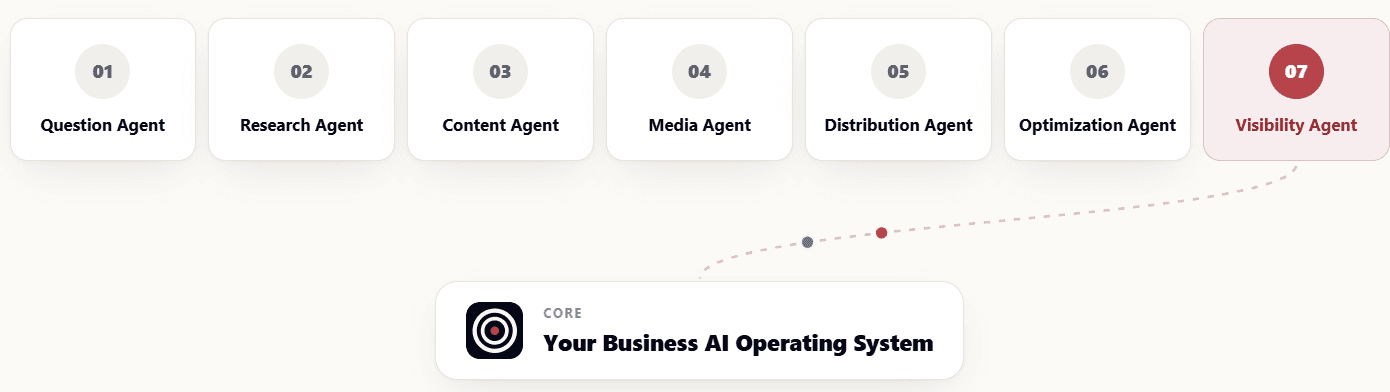
Done for you. You just approve.
About this report: Liron Segev, who built Answer Content Engine, conducted the study. This was research into AI recommendations and citations, not a trial measuring Answer Content Engine customer results.
We get results
This is what results look like for some of our clients:
of AI category mentions for a solo real estate agent, up from zero.
of category mentions for a sports consulting business, nearly 3x its nearest competitor.
most-mentioned storage facility in its category: 38 AI mentions, 32 first-page Google spots.
Anonymized client results from live Answer Content Engine dashboards, April to June 2026. They are not results from this study.
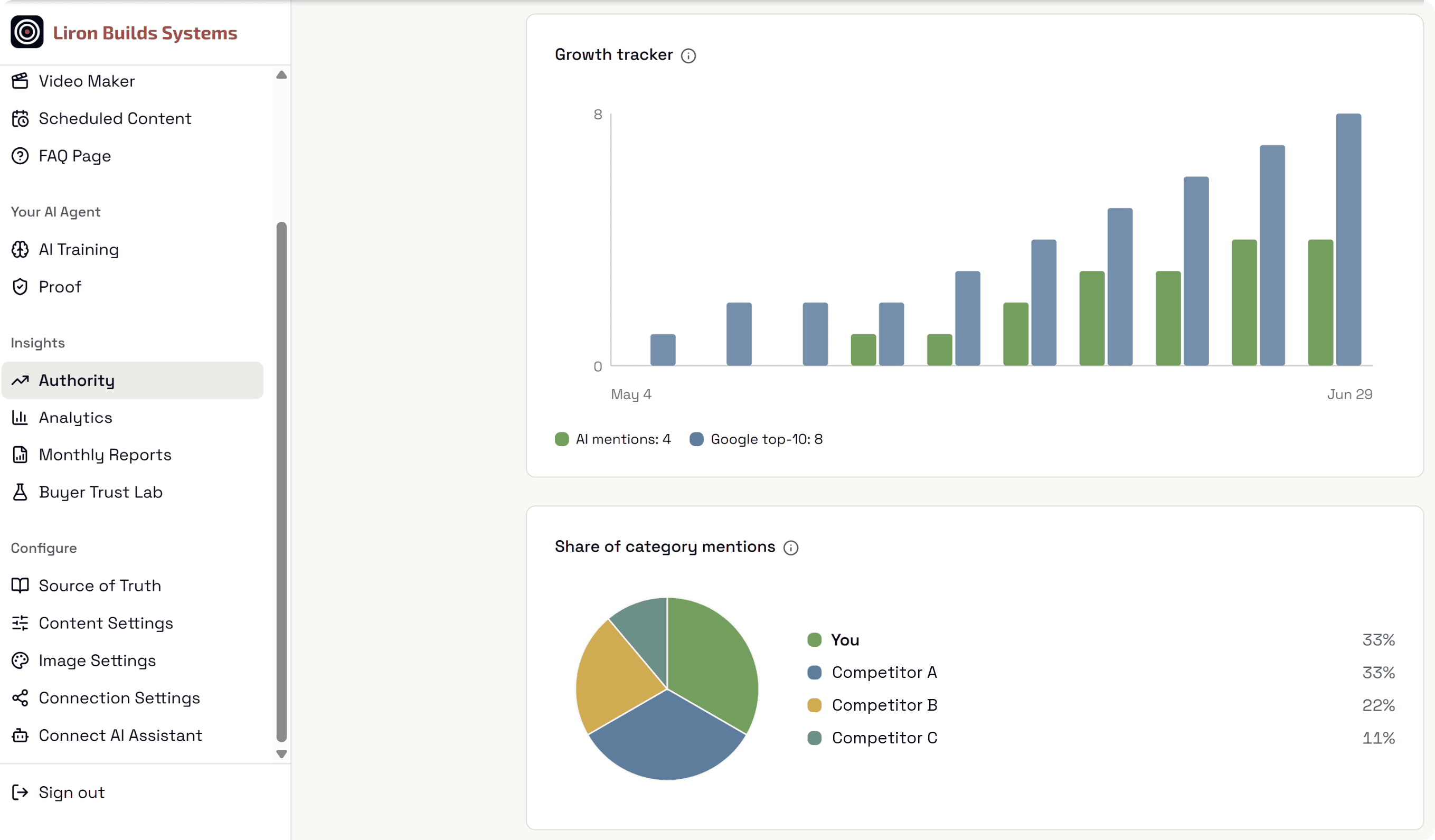
The Authority page in your portal tracks AI mentions, Google top-10 placements and your share of category mentions every week. Competitor names hidden.
Your customers are asking AI questions. You need to be the answer.
- You own the system
- Not a SaaS tool
- Built by data nerds
Book a call to see how it works for your business.
Don't wait until your business is completely invisible in AI. Is it not worth a 15-min chat?
How we did thisThe full method: models, dates, metros, industries and quality checks.
Here are the details of what we did:
We didn't just ask AI a handful of questions. We collected 12,792 answers from OpenAI, Claude and Gemini models. Our core local-business research covered 12 metros and 8 service industries.
Then we examined 3,127 business websites to investigate what separated the businesses AI named from those it never mentioned.
We built the investigation around 96 local markets, repeated fixed questions, and tested AI both with and without web search.
We checked business identities against Google Maps, compared website content, and matched businesses with similar review counts to test whether the content difference remained.
A separate experiment examined the sources AI cited when buyers asked about costs and choices.
That depth matters.
An isolated answer can reveal a business name.
Repeated, structured testing lets us examine how consistently businesses appear, compare them with their competitors, and assess whether an observed difference is statistically significant. The findings in this report come from that investigation.
Our investigation had 3 stages
1. Ask which businesses AI names
From September 5–8, 2026, we collected 12,504 answers from 3 AI models. The main experiment used 248 distinct questions, repeated across 4 days, including commercial service questions and control questions.
We asked both for recommendations and for businesses the models knew about. For example:
“I'm looking for a financial advisor in Denver, Colorado. Who would you recommend?”
“What are some financial advisors in Denver, Colorado that you know of?”
The wording was fixed for each category and question type, with the city substituted consistently. Repeated responses let us examine patterns beyond a single answer.
2. Compare the businesses' websites
We collected 5,426 Google Maps listings across the 96 local markets, each covering a service in a city. From those, 3,127 businesses had readable lists of their website pages.
That let us compare websites belonging to businesses AI named with websites belonging to businesses it never named in our sample.
3. Ask the questions buyers consider before hiring
On September 10, we asked 16 cost and comparison questions across 6 cities, using the same 3 models with web search enabled. That produced 288 additional answers.
We then classified the cited sources and the types of local-business pages among them.
| Investigation | Scale |
|---|---|
| Main AI experiment | 12,504 answers |
| Website comparison | Page lists from 3,127 business websites |
| Buyer-question follow-up | 288 answers |
| Total AI answers analyzed | 12,792 |
These are answer counts, not counts of unique questions or individual web searches. Repetition was part of the design. The website investigation was a separate data collection exercise, not additional AI answers.
12 metros, chosen deliberately
Local businesses operate in very different markets. We included 4 large, 4 midsize and 4 small metropolitan areas, or metros, using the study's predefined size groups.
| Large metros | Midsize metros | Small metros |
|---|---|---|
| Chicago, Illinois | Nashville, Tennessee | Boise, Idaho |
| Minneapolis, Minnesota | Tucson, Arizona | Chattanooga, Tennessee |
| Atlanta, Georgia | Albuquerque, New Mexico | Peoria, Illinois |
| Denver, Colorado | Rochester, New York | Fort Wayne, Indiana |
We started with 17 candidate metros.
Before the main run, we measured how often search results included pages listing businesses, such as “best” or “top” local-service lists. This gave us a consistent, if imperfect, way to compare that type of online coverage across markets.
We chose metros with a range of that measured coverage within each size group. Chicago and Fort Wayne were retained to preserve continuity with earlier pilot work. The final 12-city list was frozen before the main experiment.
This was a deliberately varied sample, not a random sample representing every US business or city.
8 service industries, 4 business groups
| Business group | Industries examined |
|---|---|
| Professional services | Financial advisors; business attorneys |
| Local trades | HVAC companies; plumbers |
| Real estate services | Real estate agents; property management companies |
| Local practices | Dentists; speech therapists |
These categories represent services customers hire, including both individual practitioners and companies. Their mix allowed the study to examine different kinds of local service decisions rather than treating one trade as representative of them all.
8 industries × 12 metros = 96 local markets.
The broader experiment also included 2 local control categories, auto repair and restaurants, plus 8 national test questions covering consulting, product purchasing and business software.
They helped distinguish answers naming local independent businesses from other kinds of recommendations. The headline findings here focus on the 8 commercial local industries.
The buyer-question follow-up covered Chicago, Atlanta, Albuquerque, Nashville, Fort Wayne and Boise: 2 metros from each size group, across all 8 industries.
What “with web search” means
AI can answer using information learned during training. It can also be given access to web search to find information for the question in front of it. We tested both conditions.
| Condition | In plain language | What we examined |
|---|---|---|
| Existing knowledge | Web search was disabled. The model answered using information learned during training, without looking up websites for that response. | Which businesses the model could name from its existing knowledge. |
| With web search | The model could search online and use the results in its answer, including providing citations. | Which businesses it named and which pages it cited when search was available. |
Why test both? A business appearing in a model's existing knowledge and a business appearing in its online sources are different routes into an answer. Combining them without labels would hide that distinction.
| Condition | Main experiment | Buyer follow-up | Total answers |
|---|---|---|---|
| Existing knowledge | 11,088 | 0 | 11,088 |
| With web search | 1,416 | 288 | 1,704 |
| Total | 12,504 | 288 | 12,792 |
Search being available does not mean every response used it or included a citation. We count answers produced in that condition, not individual searches performed behind the scenes.
We tested OpenAI GPT-5.6, Anthropic Claude Sonnet 5 and Google Gemini 3.6 Flash through an API, a software connection to the models. The consumer apps manage their own search, prompts and answer presentation, so this is a study of the tested models and settings rather than a direct test of the apps.
Being named and being cited are different
There are 2 outcomes in this report that a business should keep separate.
| Outcome | What the buyer sees | What we measured |
|---|---|---|
| Named in the answer | A business appears in the response text, such as a provider offered for consideration. | Whether a local independent business was named, and how often. |
| Cited as a source | A business page appears as a supporting link. | Which pages and businesses supplied citations. |
When we asked who to hire, 57.9% of own-business-site citations went to homepages. When we asked cost and comparison questions, 70.6% of local-business page citations went to answer or pricing pages.
Those are different question sets and citation samples. Their contrast shows why a website needs to be considered in the context of the buyer's question.
A link to a business's website is not automatically a recommendation to hire that business.
Method and interpretation
Study scope
The main experiment collected 12,504 answers across 4 days, September 5–8, 2026. The website investigation and 288-answer buyer-question follow-up were completed on September 10. Test runs were excluded from the reported answer totals.
The 3 models were Anthropic Claude Sonnet 5, OpenAI GPT-5.6 Sol and Google Gemini 3.6 Flash, accessed through OpenRouter. We used each provider's default settings for how the model reasons and generates answers. The consumer apps were not directly tested.
Geographic selection
17 candidates were assigned to the study's large, midsize and small metro groups. Before selection, we measured titles suggesting business lists among up to 100 organic search results per service-and-city query. We put those measurements on a common scale and combined them across 7 commercial categories. Business attorneys remained a full study category but were excluded from the selection measure because search results were incomplete or inconsistent. We selected a range of scores within each size group; Chicago and Fort Wayne were retained from the pilots. These are study groupings, not a claim to official population thresholds or national representativeness.
Repetition and controls
The main experiment used fixed recommendation and existing-knowledge questions, with consistent city substitutions, plus control questions. Repeated answers are repeated observations of the same questions, not independent samples of US markets. The 12,792 total includes controls and both search conditions; each finding identifies the sample it uses.
Business names and verification
Distinct business names from the existing-knowledge condition were checked against Maps, with further web checks for unmatched names. Identity matching accounted for naming variations. The web-search recommendation names did not receive the same full verification; some website matches used names, which introduces uncertainty.
Website comparison
The sample began with Maps pages 1–3 across 96 commercial markets. Website inventories were readable for 3,127 businesses. Chains, directory or brokerage sites, and ambiguous identity matches were removed under the analysis rules. Content counts excluded property listing feeds. Page types were inferred from addresses. The main close-review comparison retained 348 pairs; equal content-page counts were excluded from the percentage calculation.
Citation follow-up
16 cost and choice questions, 2 per commercial industry, were asked in 6 cities to 3 models: 16 × 6 × 3 = 288 answers. The analysis recorded 492 page citations, including 177 classified as local-business pages. Repeated links within an answer were counted once; a page cited in different answers could count again. Local classification used Maps website matching and state-level geography, with an allowance for listings without addresses. Government, nonprofit and media listings were excluded from the local-business group.
Quality checks
The main classifier was checked against 100 held-out answers labeled by hand. Agreement was 88.0% across answer categories and 96.0% on whether an answer named a local independent business. The final datasets reported no errors or unclassified answers. These checks assess processing reliability; they do not certify every statement generated by the models.
What the evidence can establish
The website findings are observational. Matching reviews improves comparability but cannot isolate the causal effect of content. The content advantage was clearest for existing-knowledge naming; the search-only comparison was inconclusive. The buyer-question follow-up showed the types of pages cited, but its 43 reviews-matched business pairs were insufficient to establish that more content causes more citations.
This report focuses on content, reviews and citation opportunities within a broader experiment. Findings outside that focus and detailed analytical notes are retained in the full study record.